Friday, September 27, 2013

Tasks undertaken
1, Updated revised topic statement
2. Viewed and took notes on STEMx web conferences
3. Read for a second time chapters 1-2 Frankel Text
4. Filled out problem sheet one and two from text chapters
5. Revised topic paper
6. Researched applicable SSCI journals using list of provided from Dr. Lee

Time spent on each
1. .5 hour
2. 2 hour
3. 2 hour
4. 2 hour
5. 3 hour
6. 2 hour

Results
1.  Submitted
2. Gained content knowledge for basis of implementation of a stem based classroom.
3. Took notes on all useful terms and definitions
4. Updated my topic and aligned the problem statement to something that will be testable.
5. Incorporated problem statement from text problem sheets one and two.
6. Added references to topic paper.

Reflections
This stage of my project would be much clearer if I was enrolled in the methods course in STEM education that I wanted to participate in.  Currently much of my time is being spent on revisions that would be easily accessed if I was enrolled in the Endeavor STEM leadership certificate program.   

This problem statement for my topic is hard to develop.  I am going to revisit the textbook to see if I can gain some insight as it pertains to my topic.


Text is friendly but I am studying the details as if I needed to take a test in a college class.

I really could use a science specific resource person.  This type of education course is useful but in the context of day to day teaching having someone that knows the content and can provide meaningful suggestions including knowledge of content would be ideal and practical for my daily teaching.

Monday, September 23, 2013


NOAA Satellite

The autumnal equinox yesterday at 16:44, sees the daily periods of daylight waning and the periods of darkness are becoming longer. Fall is a decent time of year and with predictable patterns which exist at the mid-latitudes.
My topic paper relied on work that was completed last fall in INTC 5160. I will be toiling with implementing STEM (Science, Technology, Engineering and Math) through:
Eyes in the Sky II An opportunity for teachers and their students to observe, investigate, and understand our planet using an eyes-in-the-sky perspective.
ImageJ is free public domain image processing software developed at the National Institutes of Health. Its power and flexibility allow it to be used as a research tool by scientists in many disciplines, from medicine to astronomy.
GLOBE (Global Learning and Observation to Benefit the Environment)
Atmosphere protocols.

Thursday, March 22, 2012

Contributing factors for the lack of snow in the winter of 2011-2012

These images show the difference in snow coverage in North America between this winter and last winter.  Two contributing factors for the lack of snow in the winter of 2011-2012 were the positive phase of the Arctic Oscillation (AO)  and the La Nina event.   During La Nina systems carrying moisture tend to develop less frequently. The diagram of the (AO) shows that during a positive phase, cold air is trapped in its source region over the high latitudes of the northern hemisphere. This blocking supports and strengthens the La Nina.  In addition during positive phases of the Arctic Oscillation the jet stream takes a more northern course steering snowstorms towards Alaska.
Even with all of this, I am still holding on to hope for a decent Easter snowfall in New England.  We are not going to hike the Teardrop this weekend, but still plan on hitting the White Mountains of New Hampshire.
Winter 2011-2012 Image 3/5/12
                                                                        

Winter 2010-2011 Image 3/3/11

                           Postive on the left (winter  2011-12 )                      Negative on the right
Arctic Oscillation

Arctic Oscillation current winter 2011-12

Arctic Oscillation last winter 2010-11

Friday, March 16, 2012

Ahead of Schedule


The long term forecast is predicting above average temperatures for the North Country.  Luckily my wife Julie and I went out skiing last weekend.  These photos are from Saturday 3/10/12.  It snowed the Friday night before; this fresh snow added to the coverage. 
Spring has arrived about 4-6 weeks ahead of schedule.  Many of the snowfields of Vermont and New Hampshire are suffering because of the heat pump associated with a persistent southerly flow.  This year the spring hike in Tuckerman Ravine will more than likely require you to hike out rather than ski out.  I am looking forward to possibly hiking up and then skiing the Teardrop trail on 3/24/12. This trail is on the western side of Mt. Mansfield and was cut by the CCC in 1937.
This is an image from the 1930's of the CCC crew that cut the first trails on Mt. Mansfeild.(Teardrop, Nosedive, Bruce Trails)  They are pictured in front of their Ranch Camp.
The CCC crew at the Ranch Camp

Saturday, March 3, 2012

National Weather Service Visit

I am taking an Earth’s Climate System course through the American Meteorological Society SUNY Brockport.  On Wednesday evening, participants in the course had a meeting at the National Weather Service Office in Mt. Holly N.J.  The headquarters for the NWS serving the Philadelphia area, southeastern New Jersey, and northern portions of Delaware and Maryland.  It is the second time I have had the opportunity to visit the forecast office and after each visit I am more excited to teach about the local weather and climate.
Our next meeting is to be held at CBS 3 on April 24, 2012 in Philadelphia.  We will sit in on the evening news broadcast.  Our focus is the weather report provided by Kathy Orr. After the news broadcast we are permitted to pretend we are weather broadcasters.  It is cool to work the green screen, you just have to make sure you do not wear green, or that portion shows up blank on the monitor.  This Climate course is one of a kind and it provides many connections to my teaching.  Plus it is free and upon completion you earn 3 graduate credits.


Monday, February 27, 2012

Finally

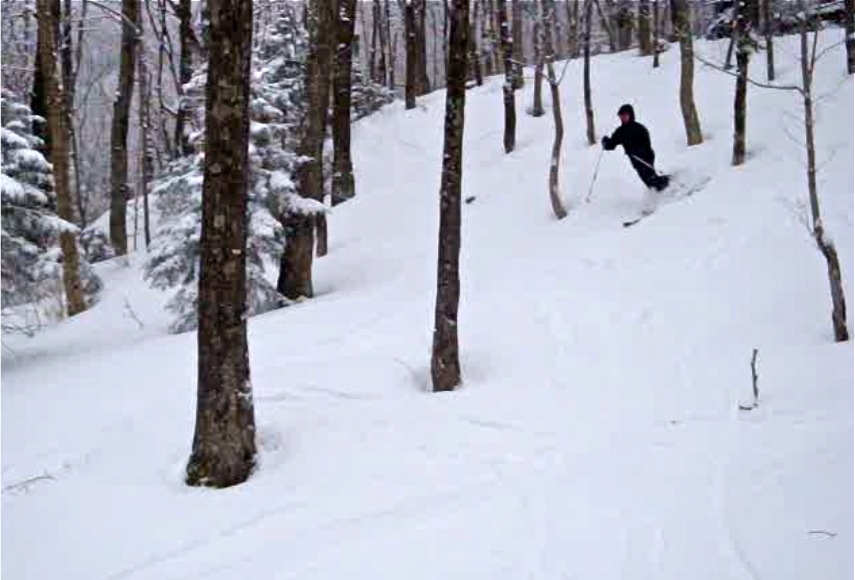
This weekend my wife and I telemarked skied at Stowe Mountain and Smuggler’s Notch Ski Areas. We were very fortunate because it snowed, and snowed, and snowed. The powdery white snow was a welcome site to locals and visitors alike.  During the winter all major New England ski resorts have been lacking natural snow.
Accumulations had reached about 3 feet by Sunday. This bottomless powder was a welcome site to our family and we are hoping for a strong showing of Northeast storms for the months of March and April.


Saturday, February 11, 2012

Stone Hut


The Stone Hut serves as a public lodging facility.  It operates as a primitive shelter from mid-November to mid-April.  The shelter sleeps up to a dozen people.  Interested hikers or skiers can request a reservation via mail from September 15 through November 1. The Stone Hut was built in 1936 by Civilian Conservation Corps (CCC).  These crews cut the first trails on Mt. Mansfield and this was used as “home away from home” for these early skiing pioneers. 
My family intends to reserve the hut during an upcoming winter.  Preparation requires gear for winter camping.  You would need to bring food and a stove, along with proper sleeping pad and bag.  This type of building is very unique it has a good feel to it. I think it is the fact that it has stood up against Mother Nature for many years.   I am looking forward to the trip we organize to visit the Stone Hut on Mt. Mansfield.